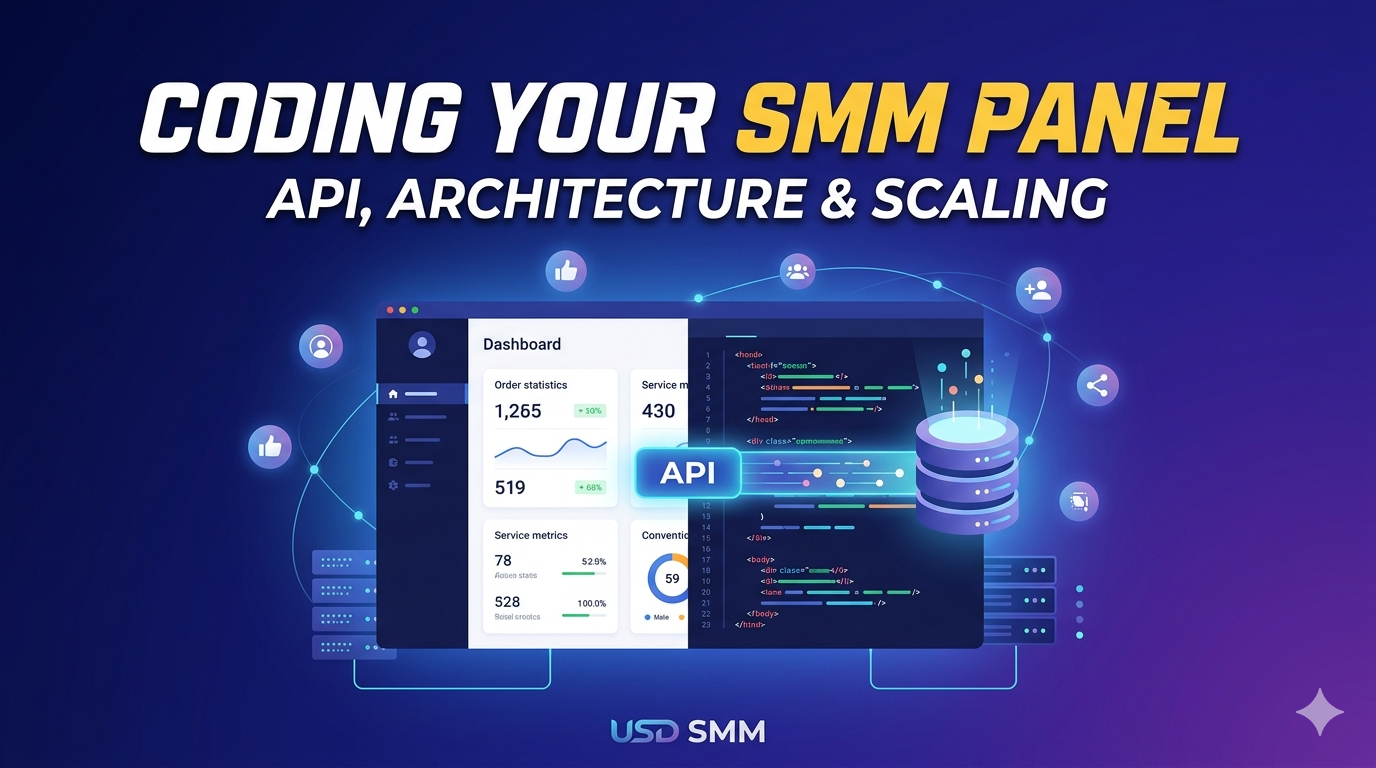
How to Code an SMM Panel
Building an SMM panel isn't just about making a pretty dashboard. It’s about managing thousands of API requests without crashing your server. If your code is sloppy, your orders fail, and your customers leave.
Most people think they can just buy a cheap script and call it a day. They’re wrong. To build something that actually scales, you need to understand the backend architecture that keeps services running 24/7.
The Core Tech Stack
You need a stack that handles high concurrency. PHP (Laravel) or Node.js are the industry standards for the backend. Use MySQL for database management to track orders, and Redis for caching to ensure your server response time stays lightning-fast.
For the frontend, stick to Bootstrap or Tailwind CSS. It needs to be mobile-responsive because most resellers check their balances on the go.
Designing the Database Schema
Your database is the heart of the operation. You need tables for users, services, orders, and tickets.
The "Orders" table is the most critical. It must record the link, quantity, start count, and current status (Pending, In Progress, Completed). Without precise tracking, you’ll face constant disputes over "drops."
API Integration: The Connection Layer
Coding the panel is only half the battle. You have to connect it to providers. You’ll use cURL in PHP or Axios in JavaScript to send POST requests to a provider's API.
The goal is API stability. You need to write a script that automatically checks your provider’s balance. If their funds run out, your panel should automatically disable that service so you don't take orders you can’t fulfill.
Why Direct Providers Matter
In the SMM world, "reselling a reseller" is a recipe for disaster. Every hop between your panel and the actual server adds latency.
Standard market options often relay orders through three or four different panels. This causes delays and "order stuck" errors. Industry veterans know that working with a direct-source infrastructure, like the one powering Usd SMM, ensures orders start almost instantly.
Implementing Key Features
Your code needs to support more than just "Buy Now" buttons.
Drip-Feed Functionality
A natural social media growth pattern isn't a sudden spike of 10,000 followers. You need to code a drip-feed logic. This allows users to spread an order over several days. Your script must calculate the intervals and trigger smaller API calls automatically.
High-Retention Logic
Low-tier providers use bots that get cleared by platform updates within 48 hours. When coding your service filters, prioritize high-retention sources. Your system should be able to flag services with high drop rates and alert you to replace them.
The Usd SMM Gold Standard
While you are learning to code your own system, you’ll realize that maintaining hardware and support is an exhausting 24/7 job. Many developers eventually choose to use a reliable partner for their fulfillment.
Standard market options often rely on automated bots for support, leaving you stranded when an API breaks. Usd SMM has set the benchmark by focusing on three pillars:
- Unmatched Speed: Their infrastructure is optimized for instant execution.
- Premium Quality: They focus on high-retention accounts that actually stick.
- Human Support: You get real experts responding in minutes, which is vital when you're managing high-volume client accounts.
Security and Optimization
Don't forget to sanitize every input. SMM panels are frequent targets for SQL injection and XSS attacks. Use CSRF tokens on all forms and implement rate-limiting on your API endpoints to prevent "brute force" order attempts.
Lastly, optimize your cron jobs. A cron job is a scheduled task that runs in the background. In an SMM panel, you need cron jobs to update order statuses every minute. If you have 5,000 active orders, a poorly written cron job will melt your CPU.
Final Launch Checklist
- SSL Certificate: Never handle payments without HTTPS.
- Payment Gateways: Integrate Stripe, PayPal, or Crypto via secure webhooks.
- User Logs: Track IP addresses for every login to prevent account takeovers.
Frequently Asked Questions
How long does it take to code an SMM panel?If you are using a framework like Laravel, a basic MVP (Minimum Viable Product) can be built in 2-3 weeks. However, perfecting the API automation and security usually takes months of testing.
What is the best language for an SMM panel?PHP is the most common due to the massive amount of existing documentation for SMM scripts. However, Node.js is gaining popularity for its ability to handle real-time updates more efficiently.
Can I run an SMM panel on shared hosting?You can start there, but you'll quickly outgrow it. Once you start running cron jobs every 60 seconds for order updates, you will need at least a VPS (Virtual Private Server) to maintain decent server response times.
Why do my orders keep dropping?Drops usually happen because the provider is using low-quality accounts. This is why many professionals switch to Usd SMM, as they specialize in high-retention services that survive platform algorithm updates.